Miraeyeon Clinic
- HOME
- Miraeyeon Clinic
- Infertility Clinic
Infertility Clinic
Intrauterine Insemination (IUI)
For pregnancy to occur, sperm must first pass through the vagina, enter the cervix (the narrow passage at the lowest part of the uterus),
then travel through the uterine body and fallopian tubes to meet the ovulated egg outside the ovary for fertilization.
The number of sperm that can pass through the narrow cervix is limited,and intrauterine insemination is a method in which sperm are washed and concentrated,
then inserted directly into the uterine cavity through a thin catheter instead of through the cervix.
This shortens the path that sperm must travel to reach the egg, allowing more sperm to reach the egg.
01Cases Where IUI is Helpful
-
Unexplained infertilityif infertility examinations show no abnormalities but pregnancy has not occurred after more than one year of attempts in women under 35, or after more than 6 months of attempts in women 35 or older, intrauterine insemination is performed to increase the pregnancy rate.
-
Mild Male Infertility
-
Infertility due to ovulatory factorsby using ovulation-inducing agents to ovulate multiple oocytes, the pregnancy rate can be increased.
-
In addition to other caseswhen the cervical mucus is too sticky for sperm to pass, in rare cases when there is an allergy to sperm…, when a man has frozen sperm for fertility preservation, when there is male sexual dysfunction, and for various other reasons, intrauterine insemination is performed.
02Precautions for intrauterine insemination
Intrauterine insemination is a relatively simple and safe procedure, and the likelihood of serious adverse effects is low; however, the following adverse effects may occur.
-
Infectionafter intrauterine insemination, there is a possibility that infection may occur in the ovaries, fallopian tubes, and uterus.
-
Small amount of vaginal bleedingduring the process that requires inserting a catheter into the uterus, bleeding of the cervix may be induced. However, the presence of vaginal bleeding does not mean the pregnancy rate decreases.
-
Multiple pregnancyintrauterine insemination itself does not increase multiple pregnancy (twins, triplets…).
However, when multiple oocytes are released by using controlled ovarian hyperstimulation medications, the possibility of multiple pregnancy increases. Compared with carrying only one baby, multiple pregnancy is associated with preterm labor or low-birth-weight delivery. Because the risk increases, effort is made to induce ovulation of a suitable number (2–4) of oocytes.
03Preparation process and method for intrauterine insemination
In the case of the woman, the ovulation time is predicted through periodic ultrasound examinations or by using a urine luteinizing hormone test kit that can identify the ovulatory period. To perform the procedure at a more accurate timing, an injection that helps ovulation may be administered.
Once the ovulation timing is determined, intrauterine insemination is performed on that day. For this, the man must submit semen (or previous… may interfere with fertilization), so the collected semen is washed and separated to concentrate healthy, highly motile sperm.

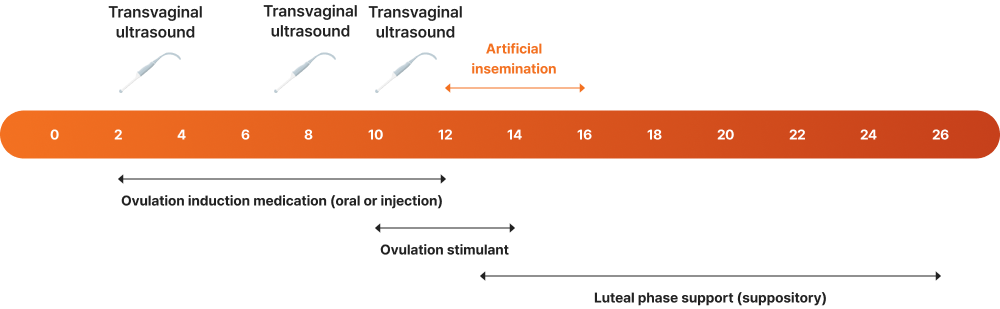
For intrauterine insemination, when the patient lies on the examination table in the same position as when receiving a cervical cancer screening, a thin catheter is in… Even if you engage in general daily activities, it does not affect the pregnancy rate. A small amount of bleeding may occur for 2–3 days starting from the day of the procedure.

- Semen collection
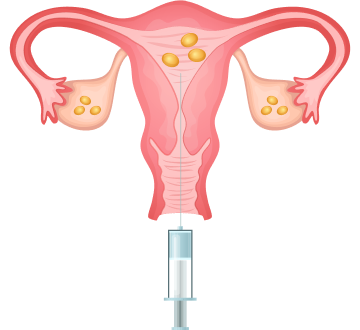

- Sperm insertion
through a
catheter