Miraeyeon Clinic
- HOME
- Miraeyeon Clinic
- Infertility Clinic
Infertility Clinic
Infertility Examination
If a couple has attempted pregnancy without contraception but even after one year pregnancy has not occurred,
or if the woman is 35 years or older and pregnancy has not occurred even after 6 months, it is advisable to undergo an infertility examination.
01Interview Examination
We conduct a medical interview, assess the basic overall health condition, and perform a gynecological examination.
02Hormone Examination
On days 2–4 of menstruation, a blood examination is performed to check the hormones involved in ovulation and pregnancy.
03Transvaginal Ultrasound Examination
We examine the overall condition of the uterus and ovaries.
It may be performed regardless of the menstrual cycle, or depending on whether abnormalities are to be identified through the examination (endometrial changes according to the menstrual cycle, polyps, fibroids, intrauterine adhesions, and other endometrial lesions, etc.), the timing of the examination may vary.
04Hysterosalpingo-contrast Sonography (HyCoSy)
It is performed after menstruation has completely ended and before ovulation, to examine the condition of the uterine cavity and whether the fallopian tubes are open.
Examination Method
At our clinic, we perform hysterosalpingo-contrast sonography (HyCoSy) using 4D ultrasound, which is known to significantly increase the accuracy of the examination compared to using conventional 2D ultrasound.
The ultrasound contrast agent used in this examination is not covered by insurance (non-reimbursable item).
Total duration: 5–10 minutes
STEP 01The examination is performed from just after menstruation ends until before the ovulatory phase.
STEP 02A thin catheter is inserted into the uterine cavity.
STEP 03Ultrasound contrast agent is injected into the uterine cavity through the catheter.
STEP 04Using ultrasound, the flow of contrast into the uterine cavity and both fallopian tubes is observed to confirm endometrial abnormalities and whether the tubes are open or closed.
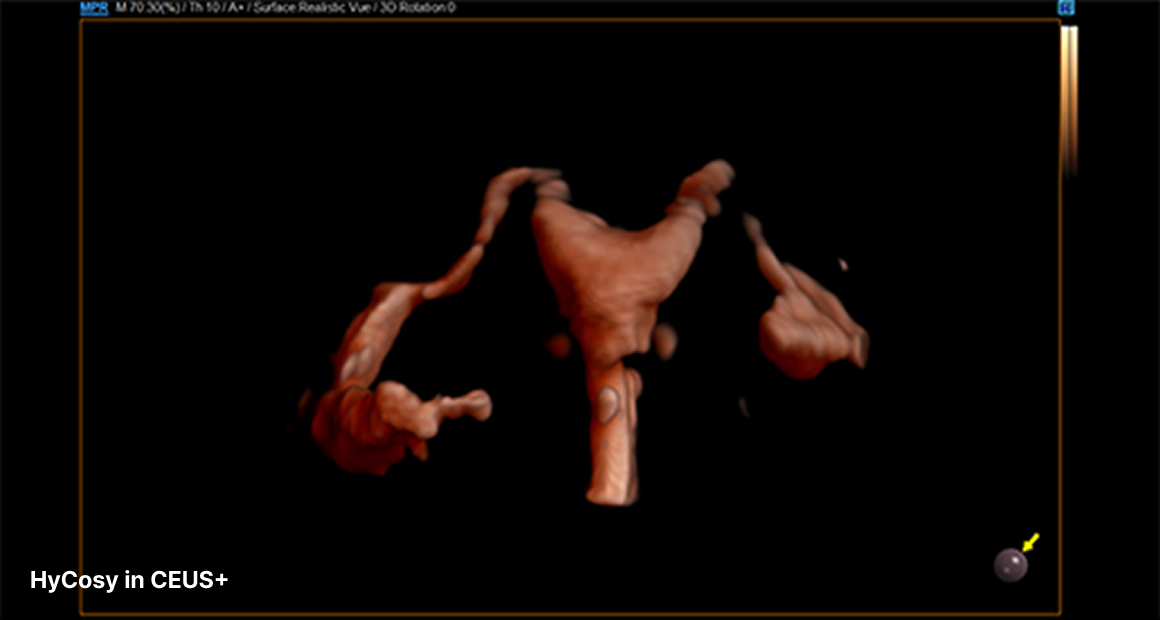
- 4D Ultrasound Imaging
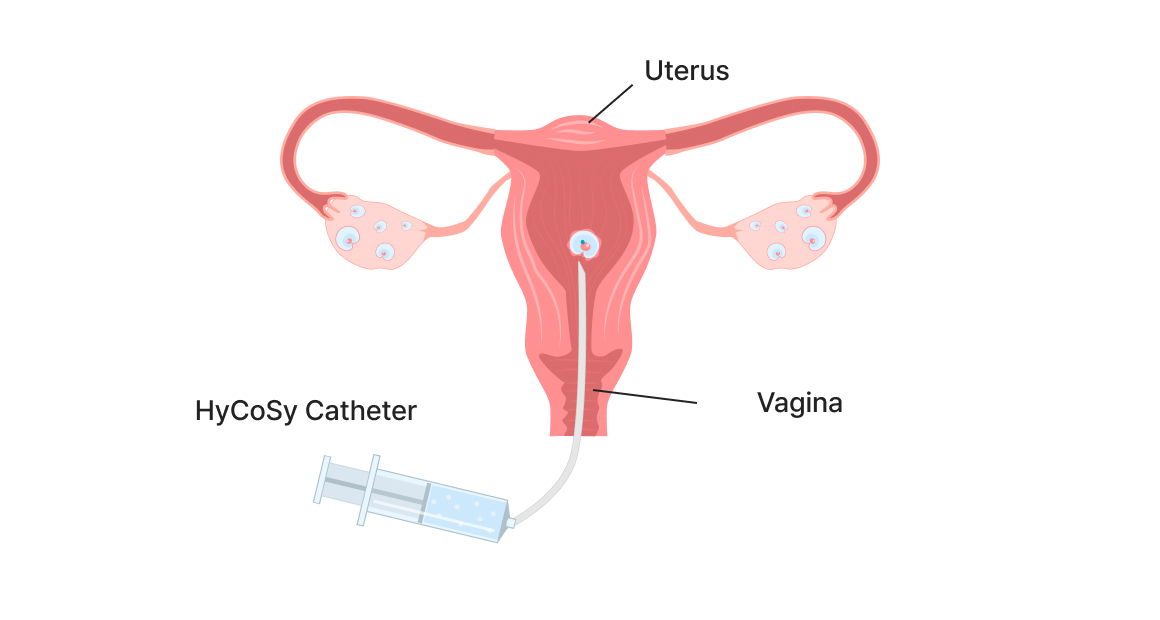
- Examination Method
Advantages of the Examination
Compared to hysterosalpingography (HSG) that uses X-rays, there is less pain and markedly fewer allergic reactions (an advantage of ultrasound contrast agents). There is also no radiation exposure.
With a single examination, it is possible to evaluate not only whether the fallopian tubes are open or closed, but also overall lesions of the uterus and ovaries as well as intrauterine lesions.
05Ovulation Ultrasound Examination
The examination begins on days 11–12 of the menstrual cycle and continues until ovulation is confirmed, checking follicular growth and corpus luteum formation after ovulation.
06Semen Examination
Through basic semen examination and detailed sperm morphology examination, we check sperm count, motility, and the proportion of sperm with normal morphology according to strict criteria.
07Hysteroscopic Examination
When abnormalities of the endometrium are suspected in hysterosalpingography or transvaginal ultrasound examination, hysteroscopy is performed to directly observe inside the uterine cavity and confirm abnormalities.
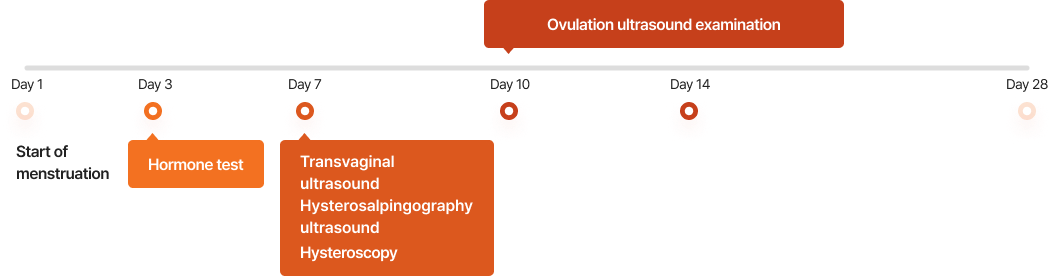
08Infertility Examinations by Menstrual Cycle
For the first visit for infertility examinations, you may come at any time during the menstrual cycle, but as shown in the following table, the examinations available will depend on the timing of your visit.
To undergo the basic infertility examinations, one full cycle is required.